

The Mayan Train is probably the most ambitious and controversial infrastructure project Mexico has seen in decades. A 1,554-kilometer railroad crossing five southeastern states (Chiapas, Tabasco, Campeche, Yucatán, and Quintana Roo) that connects destinations previously only reachable by road. It’s a genuinely comfortable way to travel around the region, though the project raises questions that still don’t have clear answers.
In this post I’ll cover how the train works, what the route looks like, which places you can visit from each station, how to buy tickets, and how to make sense of the ticket release system. I’ll also go into the bright and dark sides of a project that’s neither the paradise the government promised nor the absolute disaster its harshest critics claim.
What is the Mayan Train and how did it come about
The Mayan Train was the flagship project of Andrés Manuel López Obrador’s administration. The idea was to connect southeastern Mexico through a modern railroad that would boost tourism, create local jobs, and improve mobility for residents of the region. Construction officially kicked off in 2020 and, after several delays and controversies, the full circuit became operational on December 15, 2024.
The train is managed by FONATUR, Mexico’s national tourism development fund, though operations fall under the supervision of the Secretary of National Defense (SEDENA), which has been pretty controversial in itself. Ticket revenue goes into a trust fund managed by the Army, which is a strange setup for a tourism project.
As of now, the train has surpassed two million passengers since opening, with destinations like Cancún, Mérida, Playa del Carmen, Valladolid, and Palenque making up the bulk of traffic.
The Mayan Train route: stations and main destinations
The full circuit covers 1,554 kilometers across 34 stations. It’s not a straight line: it loops around the Yucatán Peninsula, so you can travel either clockwise or counterclockwise. Here are the most relevant stops from a tourism standpoint:
Palenque (Chiapas)
This is the western gateway to the train. It’s home to the Palenque archaeological zone, a UNESCO World Heritage Site since 1987. The ruins are among the most impressive in the country: Mayan temples rising out of the Chiapas jungle, remarkably well preserved. The Magical Village has a good vibe, craft markets, and the kind of lively chaos that tends to follow destinations with heavy tourist traffic. I caught the train here on my way to Merida, and the platform has real atmosphere: people hauling bags, heat hammering down at 35°C, and the train waiting looking far more modern than you’d expect.
Campeche
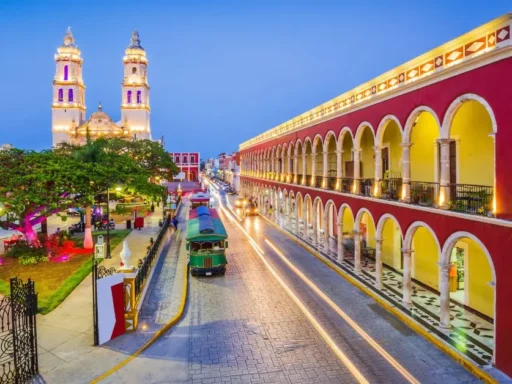
One of the most beautiful cities on the whole route. The walled historic center is a UNESCO World Heritage Site and its pastel-colored streets hook you from your very first walk around. The food is excellent: fish bread and fresh Gulf shrimp are among the best things you’ll eat on the whole trip.
Edzna (Campeche)
An archaeological zone that most tourists skip, but really shouldn’t. The Gran Acrópolis and the five-story Castillo are imposing structures from the Maya Preclassic period. Since it sits outside the usual Chichén Itzá and Tulum circuit, you can visit it without the crowds.
Merida (Yucatan)
The White City, and one of the most complete destinations on the route. The station is called Merida Teya and it’s on the outskirts, not downtown, so factor in a taxi or Uber to get to the center. That detail doesn’t always get mentioned clearly and it’s worth keeping in mind so the extra expense doesn’t catch you off guard. It’s worth it though. Merida has a cultural and food scene that outshines most of Mexico’s capitals. Nearby cenotes, henequen haciendas, the Paseo del Montejo, the Lucas de Galvez market. It’s the kind of city that needs several days to properly explore.
Chichen Itza (Yucatan)
The train station is several kilometers from the archaeological site, so you’ll need extra transportation to get there. Even so, access is much easier than coming by bus from Cancún. Chichén Itzá is one of the Seven Wonders of the Modern World and has that strange effect of being both overcrowded and genuinely breathtaking at the same time.
Valladolid (Yucatan)
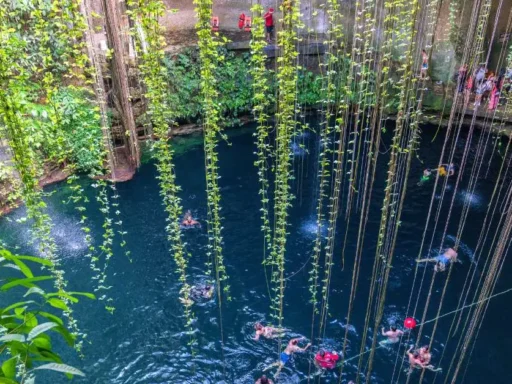
A colonial town that many travelers discover for the first time thanks to the train. It’s quieter than Merida, has a very photogenic main square, and Cenote Zací right in the middle of town. Valladolid is also just a few kilometers from Cenote Ik Kil, one of the most well-known cenotes on the peninsula.
Cancun and Playa del Carmen (Quintana Roo)
The tourist anchors at each end of the circuit. The train connects Cancun’s airport to the city and continues south along the Riviera Maya. For anyone flying in internationally who wants to do the route without renting a car, this is a solid option. The Playa del Carmen station is well placed to catch the ferry to Cozumel or continue toward Tulum by land.
Tulum (Quintana Roo)
The train does connect to this area, but the station is pretty far from Tulum’s town center and ruins. Same as at other stops: plan on local transportation when you arrive.
Other stations
The circuit also includes Boca del Cerro and Tenosique in Tabasco, Escarcega and Candelaria in Campeche, and several smaller stops along the way. Some have archaeological or natural interest, though most travelers use them as connection points rather than destinations in their own right.

Service classes and ticket prices
Tourist class: The most affordable option. Comfortable seats, air conditioning, access to the coffee car. It works well for most routes, and it’s what I took from Palenque to Merida. The seats are genuinely comfortable, so you won’t arrive with your back destroyed the way you often do after a long ADO bus ride.
Premier class: Wider seats. In theory it included catering, but that service was quietly discontinued without updating the official website, which has led to plenty of complaints from travelers who bought premier tickets expecting a meal. Before booking premier, double-check what’s actually included at that moment.
Both classes have a coffee car on board, but the food is mediocre and overpriced for what it is. For longer routes, bring your own food. And pack a light jacket even if it’s 35°C on the platform, because the air conditioning runs so cold that in the middle of Yucatan I was genuinely glad to have one.
Prices vary depending on passenger category and route distance. The system breaks down into four types:
- Local tourist: Residents of the five states on the route (Chiapas, Tabasco, Campeche, Yucatan, Quintana Roo). Requires a local INE ID.
- National tourist: Mexican citizens from other states.
- International tourist: Foreign visitors. This is the highest fare.
- Special tourist: People over 60 with a valid INAPAM card, people with disabilities, and students and teachers with valid credentials.
As a rough guide, short routes can range from 100 to 420 Mexican pesos, while longer trips like Palenque to Cancun can run between 1,000 and 4,500 pesos depending on class and passenger category. Prices change frequently, so your best bet is to check directly on the official ticket portal.
One important note: there’s no round-trip option. You have to buy tickets separately for each direction.
How the ticket release system works
This is one of the most confusing parts of planning a Maya Train trip, and it’s worth understanding before you try to sort out the logistics. I found it pretty frustrating when I first started looking: you go to the portal with a date in mind, there’s nothing available, and it’s not clear when anything will show up.
The ticketing system works through periodic releases: tickets aren’t available months in advance like on other rail systems. They go on sale in batches, with a relatively short window before the travel date. So if you try to book several months out, you’ll probably find nothing yet.
Releases typically become available a few weeks before travel, depending on the route. The process goes like this:
- Go to the official portal and select your origin, destination, and date.
- If tickets are available, choose your class and seat.
- Payment is made online by card, though you can also buy in person at the stations or at authorized points in some cities.
The practical issue is that departures are limited per destination. There isn’t a train every hour like in European rail systems: on many routes there’s only one or two departure times per day. That means if you miss a release and can’t get a ticket, the wait for the next train can be a long one. For popular routes like Cancún to Merida or Palenque to Merida, check the portal as soon as you have your travel date locked in.
Once purchased, your ticket downloads in digital format. There’s access control and ID checks at the station, so bring the same document you used when you booked.
A project with two sides: what the government promised and what actually happened
The Maya Train is the most expensive infrastructure project in Mexico’s recent history. The original approved budget was around 156 billion pesos. The final cost has climbed to over 550 billion, more than triple the original estimate. A cost overrun that, depending on the source, exceeds the adjusted budget by anywhere from 70% to 171%. None of those numbers are trivial.
And yet, two million passengers have ridden it, and the infrastructure exists and operates in a region that has historically never had decent public transport.
On top of that, critics have raised concerns about potential damage to historical and natural heritage during construction, concerns that aren’t easy to fully assess given how little transparency surrounded the project.
What works
The train has genuinely improved connectivity across the region. Before, getting between Palenque, Campeche, Merida, Valladolid, and Cancun meant either renting a car or stringing together several buses with transfers. Now there’s a comfortable, modern, direct option. I did the Palenque to Merida route in about eight hours, something that wasn’t really possible by public transport before. The train is new, quiet, and doesn’t have the bone-rattling ride of long-distance buses. You can get up, walk through the cars, use the bathroom without it being an ordeal. The trip went by without me noticing the time. For doing Palenque, Campeche, and Merida in one trip without hours on the highway, there’s nothing better in Mexico right now.
The construction also triggered one of the largest archaeological rescue operations in Mexican history. INAH worked segment by segment and uncovered thousands of pre-Hispanic structures, monuments, and artifacts along the route. In Segment 2 alone, covering 235 kilometers, over 1,000 archaeological monuments were identified. It’s the project’s central paradox: destroy to discover.
What’s worrying
The list of documented problems is long, and ignoring it would be travel-brochure journalism.
The environmental impact is the most serious and the hardest to reverse. Construction crosses 20 protected natural areas in the second largest tropical forest in Latin America, the Maya Forest. It’s estimated that between 7 and 10 million trees were cut down during the works, despite government promises that not a single tree would be felled. Segment 5, between Cancun and Tulum, has been especially destructive: the steel and concrete pylons supporting the train in that karst terrain have driven directly through caves and cenotes. There have been documented cement spills and diesel leaks that contaminated aquifers. Experts warn the damage is irreversible and threatens the region’s only freshwater source. Civil organizations have called it ecocide, and several judges ordered construction halts, though most rulings came after the damage was already done.
The impact on heritage is the other major wound. UNESCO formally requested that the Mexican government carry out a strategic environmental assessment, specifically naming Chichen Itza, Uxmal, Palenque, Calakmul, and the Sian Ka’an biosphere reserves among the sites at risk. At Calakmul, a UNESCO World Heritage Site, the train route cuts a site in half that’s home to over 350 bird species and several critically endangered ones including the jaguar, tapir, and white-lipped peccary. The government also has plans for a 150-room hotel and casino in the area.
The legal and political process raises serious questions too. When construction hit judicial roadblocks, the government declared the Mayan Train a “national security” project, which allowed it to bypass the requirement to submit environmental impact studies and continue building despite court-ordered suspensions. More than 50 injunctions were filed against various segments. Many were ruled in the plaintiffs’ favor, but arrived after the bulldozers had already moved through.
The relationship with indigenous communities is another complicated chapter. Human rights organizations, the UN, and over 300 researchers have questioned whether the consultation process with affected communities was inadequate or outright compromised. The promised economic benefits have largely not reached local communities: the Maya people don’t manage or operate the train, and many local artisans and indigenous residents see it as something imposed from outside.
Economic viability remains an open question. In the first quarter of 2025, the train required public subsidies equivalent to 25 times its ticket revenue just to keep running. If that gap doesn’t close, it represents a significant ongoing burden on public finances.
Practical tips for traveling on the Mayan Train
- Book as soon as tickets drop. Check the official portal regularly if you have a fixed date. On popular routes, tickets go fast.
- Stations aren’t always central. Budget for a taxi or Uber for the last stretch in cities like Merida, Tulum, or Campeche.
- Bring food for long routes. The coffee car exists but it’s overpriced and underwhelming. A couple of snacks and water will make the trip much more comfortable.
- Don’t forget a jacket. The AC is very strong. You’ll be glad to have a layer even if it’s 38°C outside.
- Bring your ID. It’s checked when you board, and if you bought a national or local fare, you’ll need to prove your status.
- Wi-Fi on board is unreliable. Download content, podcasts, or movies before you get on.
- For archaeological sites accessed from the train (Chichén Itzá, Edzná, Tulum), you’ll need additional transport from the station. Look into this beforehand so it doesn’t catch you off guard.
Is the Mayan Train worth it?
For crossing the Yucatan Peninsula in one go, connecting Palenque, Campeche, Merida, and Cancun without a car or a chain of buses, the Maya Train is currently the best option Mexico has in that region. The train is comfortable, modern, and it works. For short hops like Cancún to Playa del Carmen, it’s not really worth the hassle.
The scenery, though, isn’t going to blow you away. The jungle is the jungle: trees, shrubs, more trees. I think that’s the expectation problem a lot of people run into. This isn’t a scenic train through the Alps. It’s comfortable transportation connecting destinations that used to be a logistical pain without a car. If you get on looking for views, you’ll be disappointed; if you get on looking to arrive rested, you’ll appreciate it.
That said, context matters. The project behind it came with decisions that carried a high cost environmentally, archaeologically, and legally. Riding the train doesn’t mean endorsing those decisions, but looking the other way doesn’t make much sense either. Understanding where the train you’re riding came from is part of experiencing Mexico honestly.
If you get the chance, get on it. And if you can, use the trip to spend time at the stops that are still the most authentic on the route: Campeche, Valladolid, Palenque. The ones that mass tourism hasn’t quite finished taking over.