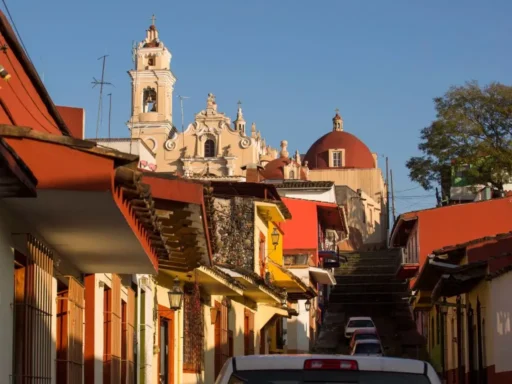


Guanajuato is an old silver-mining city where pretty much every alley, plaza, and corner comes with a story. It has a bohemian, student-town feel, colonial architecture everywhere you look, and a packed cultural calendar. To me, it’s one of the most fascinating places in Mexico.
If you’re planning a trip to this World Heritage city, this guide covers everything it has to offer, from the best sights to what to do once you’re there. I’ve also included practical tips on safety, food, and getting around.
Where is Guanajuato and how do you get there?
Guanajuato looks like something out of a fairytale. It sits in central Mexico, in the Bajío region, and it’s the capital of the state of Guanajuato (yes, same name). The city is squeezed in between mountains and hills. That’s why it feels like a maze of narrow streets, tunnels, and steep alleys.
Getting there is easy. The city has its own airport, Guanajuato International Airport (BJX), in Silao, about 30 minutes from downtown. Several highways run into the city too, so you can get there from other parts of the country by bus or rental car without much hassle. It’s about a 4 to 5-hour drive from Mexico City and about 3 and a half hours from Guadalajara.
One thing to know: Guanajuato wasn’t built for cars. The streets are just too narrow. If you drive in, leave the car outside the center and explore on foot.
A bit of history: The origin of Guanajuato
Guanajuato looks like something out of a fairytale. It sits in central Mexico, in the Bajío region, and it’s the capital of the state of the same name. The city is squeezed in between mountains and hills. That’s why it feels like a maze of narrow streets, tunnels, and steep alleys.
Getting there is easy. The city has its own airport, Guanajuato International Airport (BJX), in Silao, about 30 minutes from downtown. Several highways run into the city too, so you can get there from other parts of the country by bus or rental car without much hassle. It’s about a 4 to 5-hour drive from Mexico City and about 3 and a half hours from Guadalajara.
One thing to know: Guanajuato wasn’t built for cars. The streets are just too narrow. If you drive in, leave the car outside the center and explore on foot.
A bit of history: The origin of Guanajuato
Guanajuato’s history goes back to pre-Hispanic times. Before the Spanish showed up, this area belonged to the Chichimecas, an indigenous group from the mountains. They fought colonization fiercely and for a long time.
The Spanish arrived in the 16th century. They found huge deposits of gold and silver here and founded the city in 1559. Guanajuato started out as a mining town and went on to become one of the richest cities in New Spain.
During the colonial era, the city filled up with churches, mansions, and tunnels for hauling out the metal. The mines were so productive that, at their peak, more than a third of the world’s silver supposedly came from here.
Later on, Guanajuato played a big part in Mexico’s War of Independence. At the battle of the Alhóndiga de Granaditas, El Pípila set the building’s door on fire so the insurgents could get in. It’s one of the most remembered moments in the whole country’s history.
The city still has its colonial architecture intact, its tunnels, and that old-town vibe where every street has a story behind it.
So if you’re into history, Guanajuato is a must. You won’t just walk through streets full of legends. You’ll walk on the same ground where some of the biggest moments in Mexican history happened.
Getting lost in the historic center: The best way to get to know Guanajuato
My first tip when you get to Guanajuato: wander the cobblestone streets with no plan at all. That’s the best way to get a feel for the city. The center is packed with old mansions, cute little plazas, and alleys straight out of a storybook.
The whole center is worth your time, but there are a few places you shouldn’t skip:
Plaza de la Paz
This is the main square and the easiest place to get your bearings. Some of the prettiest buildings in the city are right here, like the Basílica Colegiata de Nuestra Señora de Guanajuato with its famous yellow facade. The square is ringed by restaurants and cafes, which are perfect for taking a break and people-watching.
Teatro Juárez
For me, Teatro Juárez is one of the most impressive buildings in Guanajuato and one of the most beautiful theaters in Mexico. The outside alone is jaw-dropping: a neoclassical facade, huge columns, and statues lining the roof. But the best part is inside. Red velvet seats, gold ceilings, and enormous chandeliers. It feels like stepping into another century.
Then-president Porfirio Díaz opened it in 1903. Since then it has hosted operas, concerts, festivals, and even events from the Festival Internacional Cervantino.
Callejón del Beso
This super narrow alley is famous for the forbidden romance between Carmen and Luis, who used to kiss from balcony to balcony. If you go with your partner, tradition says that kissing on the third step brings you seven years of good luck. Does it work if you kiss someone who isn’t your partner? No idea. Guess you’d have to try.
University of Guanajuato
The University of Guanajuato is one of the most prestigious universities in the country, and it’s also one of the city’s architectural landmarks. The main building is one of the most photographed spots in Guanajuato.
Beyond the academics, a lot of the city’s bohemian, artsy feel comes from the student life around the university. When you’re there, don’t think twice about climbing its steps. The view of the historic center from up top is really good.

Activities you can’t miss in Guanajuato
There’s more to Guanajuato than the historic center. The city has held on to a lot of its past, and that shows in how many things you can do to see its history up close.
Go up to the Pípila viewpoint:
The monument to El Pípila is one of the best-known spots in Guanajuato. I already told you who he was in the history section: a hero of Mexico’s War of Independence. From up here you can see the whole city. Go at sunset, when the lights start coming on, because the view is spectacular.
You can walk up the steps (a bit of a workout, but worth it) or take the funicular from Teatro Juárez. Either way, you get the best views of the city once you’re at the top.
Explore the tunnels and underground streets
The most surprising thing about Guanajuato is its network of underground tunnels. They were originally built to divert the Guanajuato River. Today they’re streets and avenues, which is a big reason the city doesn’t look like anywhere else.
Walking through them is weird and fascinating at the same time. Some still have colonial stonework and others are lit with old-fashioned lanterns. Go in and see them for yourself, because describing them doesn’t really do the job.
Must-see museums and historical sites
Guanajuato has a ton of museums and historical sites, and each one has its own story. These are the ones I wouldn’t skip.
Mummy Museum of Guanajuato
This is the city’s most famous museum and, hands down, the creepiest. It has more than 100 natural mummies. They’re bodies that were dug up because the families stopped paying the cemetery fees. Some of them have really unsettling expressions, and that’s a big part of why the museum is so well known.
Alhóndiga de Granaditas
One of the most important battles of Mexico’s War of Independence was fought at this building. This is where El Pípila set fire to the door so the insurgents could get inside.
Diego Rivera’s House
If you like art, go see the house where Diego Rivera was born. He’s the guy behind those huge murals, and he was married to Frida Kahlo. Inside there’s a big collection of his work, plus a lot of his personal belongings.
Callejoneadas and estudiantinas: Squeezing the most out of Guanajuato’s nightlife
The one thing Guanajuato has that you won’t find anywhere else in Mexico is its “callejoneadas” with the “estudiantinas.” It doesn’t matter if it’s your first time in the city or your fifth. It’s always a blast, the kind of night where you laugh until it hurts and really feel the magic of the place.
Here’s how it goes. Night falls, the street lamps light up the cobblestones, and you join a group of strangers, everyone holding a little clay jug (most likely with tequila or mezcal in it). Then musicians in colonial costumes show up with guitars, mandolins, and tambourines. The second they start playing, the mood changes. People clap, sing, laugh, and the “callejoneada” gets going.
The “estudiantinas” are these groups of musicians. They started in Spain, where students played in the streets to make a living. Here in Guanajuato, the tradition evolved and turned into an interactive show with music, legends, and a lot of good humor.
As you wind through narrow alleys and up staircases, the musicians tell stories about the city: doomed romances, ghosts, betrayals, and colonial-era adventures. They tell them so well that you never get bored. Before you know it, you’re belting out “Cielito Lindo” with total strangers, clinking jugs with the person next to you, and cracking up at the estudiantina’s jokes.
For me, the “callejoneadas” sum up Guanajuato’s bohemian side better than anything else. It’s the kind of night you’ll still be talking about long after you get home.

Eating in Guanajuato: A feast of flavors
The food in Guanajuato is delicious and there’s a lot of variety. Here are a few things you really have to try:
- Enchiladas mineras: tortillas filled with cheese or chicken, smothered in guajillo chile sauce and served with potatoes and carrots.
- Gorditas de maíz quebrado: stuffed with different fillings, like pressed pork rinds or beans.
- Caldo de oso: don’t worry, there’s no bear in it. It’s a fish soup with vegetables, and it’s really popular in the region.
Mercado Hidalgo is the best place to try all of this without spending much.
Is it safe to travel to Guanajuato?
In recent years, the state of Guanajuato has made the news for violence. But the capital is safe for tourists, as long as you take the usual precautions:
- Safe areas: the historic center, Teatro Juárez, the University of Guanajuato, and the Pípila are all very touristy and safe.
- Avoid walking alone at night in areas far from the center.
- Use official transportation if you need to head to the outskirts. Uber or a regulated taxi works well.
- Beware of pickpockets, especially in crowded places like the Mercado Hidalgo or during the “callejoneadas.”
In general, if you stick to the tourist areas and use common sense, you shouldn’t run into any problems.
Guanajuato won me over with its architecture, its history, and its bohemian vibe. Whether you go for the culture, the food, or just to stroll its colorful streets, you’ll always find something new.
If you haven’t been yet, I really recommend it. And if you have, you probably get why I always want to go back. Guanajuato gets under your skin, and it never really leaves.