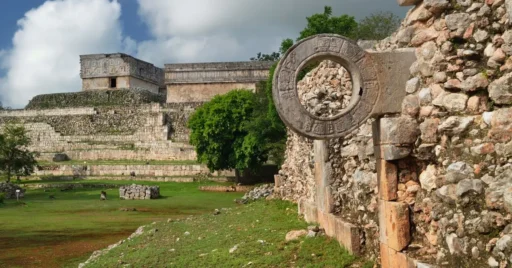

Deep in the Yucatán jungle, far from the crowds of the more popular archaeological sites, lies Uxmal, a Maya treasure that captivates anyone who discovers it with its serene beauty, flawless architecture, and a mystical vibe that wraps around everything. Visiting Uxmal is an incredible experience, one where you connect with an ancient culture and a unique, fairly unknown architectural style: Puuc style.
What’s most striking about Uxmal is its architectural design: every building is decorated with geometric details and carved figures that seem to tell (and surely do tell) their own stories. Uxmal is very well preserved and creates an atmosphere that transports you to another time.
If you’re looking for something off the typical tourist circuit on your route through Yucatán, Uxmal is one of the best choices you can make. In this guide I’ll try to tell you everything you need to know about one of the best alternatives to Chichén Itzá, so you’ll be encouraged to add Uxmal to your route and have an incredible experience:
Where is Uxmal and how do you get there?
Uxmal sits in the heart of the state of Yucatán, about 80 kilometers south of Mérida. This archaeological gem is part of the famous Puuc Route, a trail linking several ancient Maya cities that share an architectural style so distinctive you only need to see it once to recognize it.
You can certainly get there from farther destinations like Cancún, Tulum, or Playa del Carmen, but I’d recommend spending at least one night in Mérida. That way you can experience its historic center, its food, and its atmosphere, while also having the perfect base for visiting Uxmal without rushing.
How to get to Uxmal from Mérida
- By car
This is, without a doubt, the most comfortable and flexible way to explore. You rent a car in Mérida, and in a little over an hour, about 75 minutes on federal highway 261, you’ll be standing in front of the Pyramid of the Magician. The road is safe, well signposted, and has light traffic, which also gives you the chance to continue along the Puuc Route and stop at other sites whenever you want. - By ADO bus or shared van
Another option is taking a bus from the TAME terminal in Mérida. The ADO line covers the route, though schedules aren’t very frequent, so it’s worth checking and buying tickets in advance. There are also the shared vans, called colectivos, though they don’t always drop you right at the entrance of the archaeological site. - Organized tour
Mérida has plenty of agencies offering day trips to Uxmal. Many include extra stops, like the Loltún caves or the Kabah archaeological site. It’s a practical alternative if you’d rather have someone else handle the logistics while you just enjoy the ride.
Uxmal’s main attractions
The calm you feel at Uxmal contrasts with the bustle of other archaeological sites like Chichén Itzá. At Uxmal, you won’t find yourself surrounded by vendors and crowds. You can walk at your own pace, listen to birdsong, and quietly enjoy each structure. The most famous ones are:
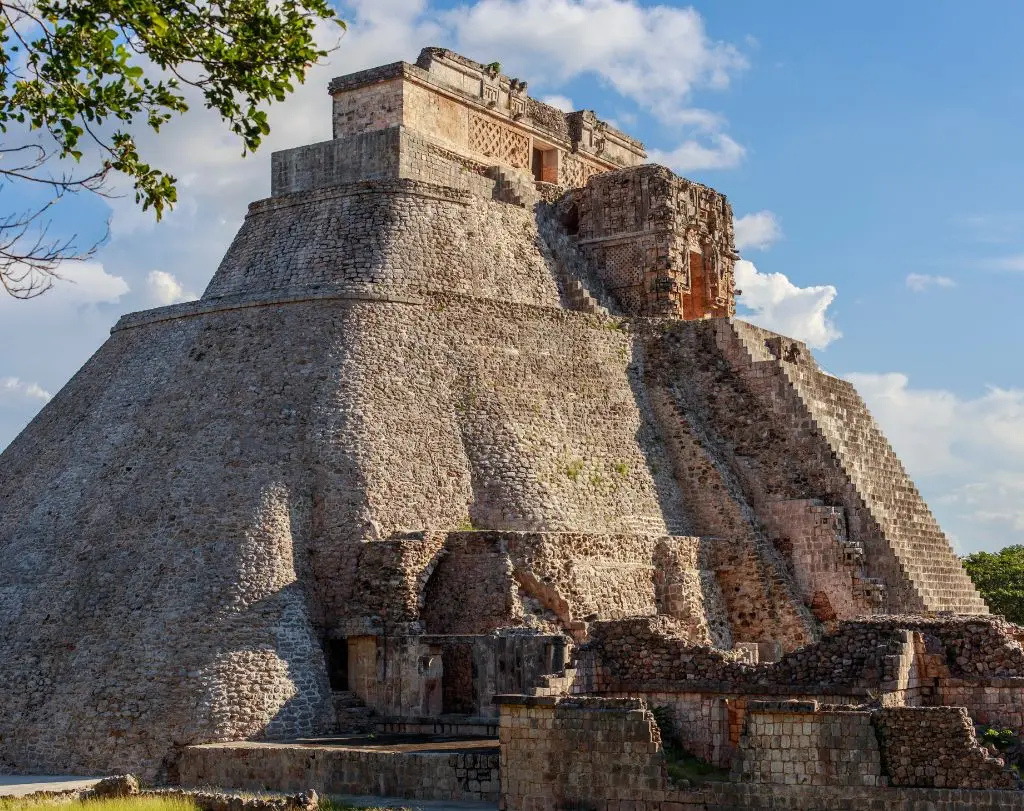
The Pyramid of the Magician
Uxmal’s undisputed star. This pyramid has an oval, curved shape, very different from the typical stepped structures found at other Maya sites. It stands about 35 meters tall, and even though climbing it is no longer allowed, seeing it up close is breathtaking.
Guides tell a legend that says it was built by a Maya child prodigy in a single night, with divine help. Obviously, that’s not true, but it does give us a glimpse into the beliefs held by the people who lived here in their time.
Nunnery Quadrangle
This architectural complex consists of four buildings arranged in a square around a large courtyard. What really stands out are the decorations on the facades: masks of the rain god Chaac, interlocking serpents, geometric frets, latticework, and human figures.
Its name was given by the Spanish, who, upon seeing the layout of the buildings, compared it to a convent, though its original function was quite different. It’s believed to have been an administrative center, a ceremonial space, or even a school for the Maya elite.
The Governor’s Palace
This is one of the most sophisticated buildings in all of Mesoamerica. The structure is over 100 meters long and sits on a large platform, offering an impressive view of the site.
The facade is richly decorated with more than 400 masks of the god Chaac, which, according to some experts, represent the importance of water in this dry region. In front of the palace stands the Jaguar Throne, an impressive sculpture symbolizing power and authority.
From its elevated position, the palace visually dominates the rest of the site. Climbing to its upper platform, which is allowed, offers excellent panoramic views. From up there, you can take in the Pyramid of the Magician, the Nunnery Quadrangle, and the jungle stretching as far as the eye can see.
The Great Pyramid
Though less famous than the Pyramid of the Magician, this one is worth keeping in mind, and unlike that one, you’re allowed to climb it. It stands about 30 meters tall, is made up of nine stepped levels, and from its summit you get the best views of Uxmal.
The Puuc Route: beyond Uxmal
Visiting Uxmal can be part of a bigger adventure if you’re up for exploring the Puuc Route, which includes other archaeological sites with similar features, each with its own personality. Here are a few stops you can add to the route:
Kabah
Kabah is another archaeological site just 20 km from Uxmal. It stands out for its Palace of Masks, also known as the Codz Poop, whose facade is covered with more than 250 masks of the god Chaac, placed side by side.
There are also other interesting structures there, like ceremonial arches, minor temples, and residential platforms, all connected by a sacbé, a white road, that once physically linked Kabah with Uxmal, reinforcing the idea that these cities formed an important political and religious network.
Sayil
About 5 kilometers southeast of Kabah lies Sayil, another archaeological site on the Puuc Route. Being less well known, with its ruins mixed into the jungle, it gives you the feeling of discovering an entirely new civilization.
What makes Sayil special is that it offers more than just monuments, it also offers a landscape full of life: butterflies, tropical birds, fruit trees, and the constant sound of the jungle accompany you along the walk. There are no vendors or crowds, just you, nature, and the ruins.
Labná
About 10 kilometers southeast of Sayil lies Labná, one of the most charming and photogenic sites on the Puuc Route. Smaller than other sites like Uxmal or Kabah, it’s known for its grand ceremonial arch. Its design is delicate yet imposing: columns, latticework, geometric frets, stone reliefs, and human figures decorate its surface, showing the extremely high level of detail the Puuc style achieved.
Besides the famous arch, at Labná you can explore the Palace, an elongated structure with several rooms, and a small temple on a platform where you can enjoy views of the surrounding jungle.

Loltún Caves
A bit further out, you can find these caves, which were used for thousands of years, first by prehistoric communities and later as a refuge by the ancient Maya. You can go in accompanied by a guide.
One of the best-known sections is the Hall of Columns, where huge stalactite and stalagmite formations have fused together, forming natural columns. Also notable are the Trenches Room, which hides traces of human shelters, and the area known as the Christmas Tree, an illuminated formation that glows as if strung with festive lights.
Tips for your visit to Uxmal
Visiting Uxmal is an incredible experience, but it’s worth keeping a few details in mind. Here’s a list of recommendations that will help you make the most of your visit:
- Arrive early: Uxmal is open every day from 8:00 am to 5:00 pm. It’s best to arrive right when it opens. That way you avoid the hottest hours and can explore the site calmly, without crowds and with the best light for photos.
- Protect yourself from the sun and heat: This area is hot almost year-round, especially between April and June. Wear light clothing, a hat, and sunglasses. It’s also important to use sunscreen and bring a bottle of water with you.
- Wear comfortable footwear: You’ll be walking over uneven ground made of stone and dirt. Comfortable sneakers or sport sandals with good grip will make all the difference. Avoid flip-flops or shoes with smooth soles.
- Take the whole tour without rushing: Uxmal has plenty of corners to explore. Take the time to read the signage or, even better, hire a local guide to explain the context and legends behind each structure.
- Consider staying for the night show: As evening falls, they put on a pretty interesting light and sound show. Plus, at night you can enjoy the structures under the stars.
- Bring cash: Admission costs 495 pesos, and although cards are accepted, they don’t always work.
- Respect and take care of the place: Uxmal is a World Heritage Site, so treat it with respect. Don’t climb onto restricted structures, don’t scratch the stones, don’t take “souvenirs” from the ground, and please, carry your trash out with you.
With this, you now have all the information you need to enjoy Uxmal to the fullest. It may not be as famous as Chichén Itzá, but that doesn’t make it any less impressive. Plus, being far less crowded gives it a unique charm, especially if you venture further along the Puuc Route. Seeing Maya ruins alone or with very few people around is a highly recommended experience.