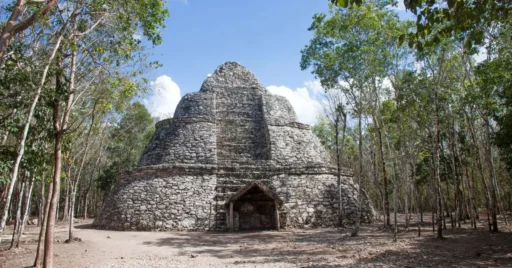

The ruins of Cobá are one of the coolest places I’ve explored in the Riviera Maya. Being tucked away in the jungle makes them unique, giving them a mysterious, authentic feel you won’t find at busier sites like Chichén Itzá or Tulum. It’s still a well-known and fairly touristy site, but it doesn’t suffer from the crowds you get at other ruins. From the moment you arrive, birdsong and the whisper of wind through the trees wrap around you, creating a magical atmosphere that makes the visit feel special. Here’s everything you need to know to visit Cobá, one of the best Maya ruins alternatives to Chichén Itzá.
A bit of Cobá’s history
Cobá was one of the most powerful cities of the Classic Maya period. It reached its peak between 600 and 900 AD, though its origins go back to 100 BC. Its importance came from its privileged location, surrounded by lagoons and connected to other cities through sacbés, a kind of Maya highway.
The sacbés, which could loosely be compared to Roman roads, formed a network of white stone paths that linked distant cities. One of the most impressive starts in Cobá and reaches Yaxuná, over 100 kilometers away. That fact alone gives you an idea of the kind of influence Cobá had in the region: political, commercial, and, of course, religious.
Today, much of Cobá is still wrapped in jungle. That dense vegetation, which seems to swallow up history, gives it a hard-to-describe air of mystery. Walking its trails, under trees that brush the sky, surrounded by the sounds of nature, feels like walking through the whispers of a civilization that still hasn’t finished telling us everything it was.
Exploring the ruins: Cobá’s main attractions
The Cobá archaeological site is large and varied, so it’s worth planning your visit well. We’re talking about an area of more than 70 square kilometers, making it one of the largest Maya settlements discovered in the Yucatán Peninsula.
However you get to Cobá, at the entrance to the archaeological site you can choose from 3 ways to explore it:
- On foot: You can walk the ruins if you have time, decent physical condition, and like taking things slow. That said, it can get pretty tiring, especially if you’re out there during the hottest hours around midday.
- By bike: The most popular option. You can rent a bike right at the entrance and move freely along all the marked paths. It’s a fun option that gives you the freedom to stop wherever you want and explore at your own pace.
- Tricycle taxi: Basically a local guide pedals for you while you sit back and enjoy the scenery. Personally, I’m not thrilled about someone else doing all the work while I sit there, but I get that it’s a good option if you have mobility issues or you’re traveling with older relatives or kids. Plus, it’s how these folks make their living.
Once you’ve picked your way to explore Cobá, all that’s left is enjoying the site. Here are the spots you shouldn’t miss:
Nohoch Mul pyramid
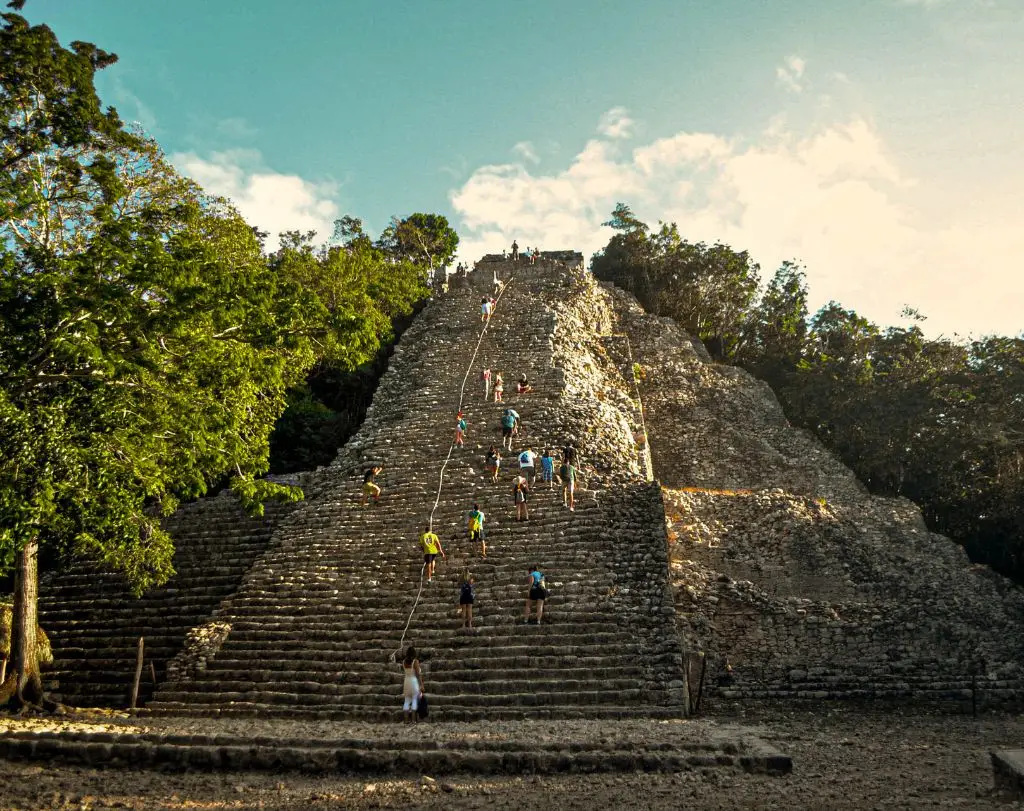
The crown jewel of the Cobá ruins. At 42 meters tall, it’s the highest pyramid on the entire Yucatán Peninsula. And unlike what happens at other ruins, you can still climb it. Getting to the top is quite an adventure. The steps are steep and uneven, and even though there’s a rope to help you, not everyone finds it easy to reach the summit. But as you’d expect, the effort is worth it. The views from up there are spectacular. You can see the jungle stretching out as far as the eye can see, which gives you a real sense of what this city must have looked like at its peak. That said, if you’re afraid of heights or not in great physical shape, it might be better to admire it from below.
Temple of the Church
This is one of the first buildings you come across in Cobá and, at 24 meters tall, it’s quite imposing. Its current name has nothing to do with an actual church. It was named that way by early explorers and archaeologists, following a habit of giving sites names tied to religious figures.
It hasn’t been restored like other temples, and the jungle partly wraps around it, giving it a mysterious feel. Several sacbés branch out from it, connecting to other ceremonial areas, almost as if it were a kind of spiritual core of the city.
The ball court
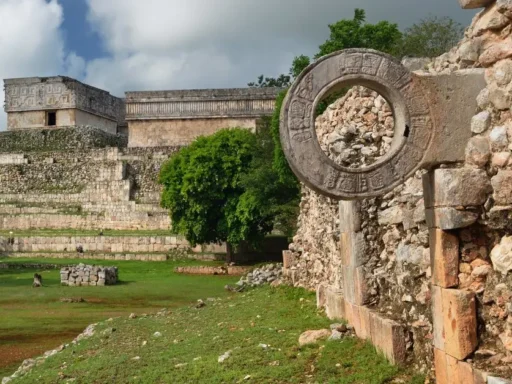
It’s not as monumental as the ones at Chichén Itzá or Uxmal, but it has its own mystique, especially in the way the vegetation surrounds and blends into it. The court is elongated, with sloped walls partly covered in greenery. Standing there, surrounded by jungle, thinking about the deeply religious meaning the game once held gives the place a very particular aura.
The Oval Temple
Located within the group known as Las Pinturas, this temple stands out for its oval base. In the Maya world, buildings were usually raised on rectangular platforms, so this structure is quite unusual.
That detail has sparked plenty of theories among archaeologists. Some researchers think the temple may have been linked to feminine rituals or fertility practices, though that hasn’t been fully confirmed. Its unusual shape, combined with the fact that it hasn’t been heavily restored, gives it a special aura. There’s something about it, maybe its silhouette or the way it hides among the vegetation, that makes it especially mysterious, very in tune with the unique vibe that surrounds Cobá.
The Macanxoc Group
This group is made up of more than a dozen carved stelae. Some of them have inscriptions and detailed figures that are still remarkably well preserved. These upright stones worked like open books from the past, used by the Maya to record important events, rituals, astronomical dates, and the genealogies of their rulers.
It’s in one of the more remote parts of Cobá, but it’s worth the walk. The strangeness of the stelae, combined with the silence and isolation surrounding them, will make you feel like you’re on a real expedition.
Practical tips for the visit
To make the most of your visit:
- Arrive early: Although Cobá gets fewer tourists than places like Tulum or Chichén Itzá, it’s still fairly popular. It can get crowded at times, especially during peak hours. If you want to enjoy it in peace, I’d recommend arriving early in the morning, around 9 am, or close to closing time.
- Factor in the extra costs: On top of the entrance fee to the ruins, you’ll need to add parking, bike rental, or a tour guide. These are costs worth keeping in mind.
- Bring insect repellent: Cobá is surrounded by jungle, and the mosquitoes show no mercy.
- Stay hydrated and wear a hat: There’s some shade, but it gets quite hot, and the sun can be intense in certain spots. Bring a water bottle with you, you’ll need it.
- Wear comfortable shoes: Ideally sneakers, whether you’re walking or biking.

How to get to Cobá
Cobá is in Quintana Roo, on the Yucatán Peninsula, and to give you a sense of location, it sits roughly between Tulum and Valladolid, about 45 minutes from each. From Playa del Carmen it’s an hour and a half, no rush needed. It’s not exactly on the way to anywhere, but that’s part of the charm. It’s tucked into the jungle, surrounded by small lagoons and dirt roads, which gives it a very particular feel. If you’re looking for something rawer, something that doesn’t feel so built for tourists, Cobá is a gem.
Here’s how to get there, depending on what works best for you:
- ADO buses: They leave from Playa, Tulum, or Valladolid. They’re comfortable, with AC and everything, but schedules are limited, so it’s best to check the app or the ticket counter ahead of time. If you don’t plan it out, you could end up stuck.
- Organized tours: There are agencies everywhere offering packaged excursions: Cobá plus a cenote plus a meal in a Maya village, or something along those lines. It’s convenient if you don’t want to drive or worry about logistics. You just show up and hop on.
- Rental car: If you like moving at your own pace, this is the winning option. You can stop wherever you feel like it, take a dip in a hidden cenote, grab a bite at a local spot, and take your time at the ruins without watching the clock.
What else can you see near Cobá?
Very close to Cobá there are several hidden gems, both natural and cultural, that are truly worth it and can add an interesting twist to your visit to the ruins:
- Choo-Ha, Multum-Ha, and Tankach-Ha cenotes: These three underground cenotes feel like a reward after walking among Maya temples. Their waters are so clear they almost look like mirrors, and taking a dip there is the perfect way to cool off after the tour. There’s also something magical about the atmosphere inside the caverns, like time stands still.
- Punta Laguna: Just 25 minutes away by car, this nature reserve blends adventure and nature in a very special way. You can zip-line over the jungle, walk trails surrounded by towering trees, or paddle a canoe while listening to spider monkeys moving through the branches. Yes, they live there in the wild, and seeing them up close is quite an experience.
- Aldea Cobá: If you’re after something beyond the touristy side of things, this place is for you. At Aldea Cobá you can spend time with Maya communities that keep many of their traditions alive. It’s a chance to truly connect with the culture that still pulses through this region, beyond the archaeology.
Visiting Cobá isn’t like just any walk through ruins. It’s more like crossing the threshold into a city that, though covered by the passage of time, still hums beneath the thick jungle. There, among roots wrapped around ancient stones and white paths disappearing into the trees, you can feel the history still whispering.
Riding a bike along its old sacbés, climbing the majestic Nohoch Mul, which you can still climb, or simply standing in silence and letting the jungle speak, these are experiences that catch you off guard. You don’t just tour Cobá, you feel it.
The funny thing is that the places that don’t top the tourist lists are often the ones that give you the most genuine moments. And without making much noise, Cobá stands as one of those gems you shouldn’t skip if you’re exploring the Riviera Maya.